
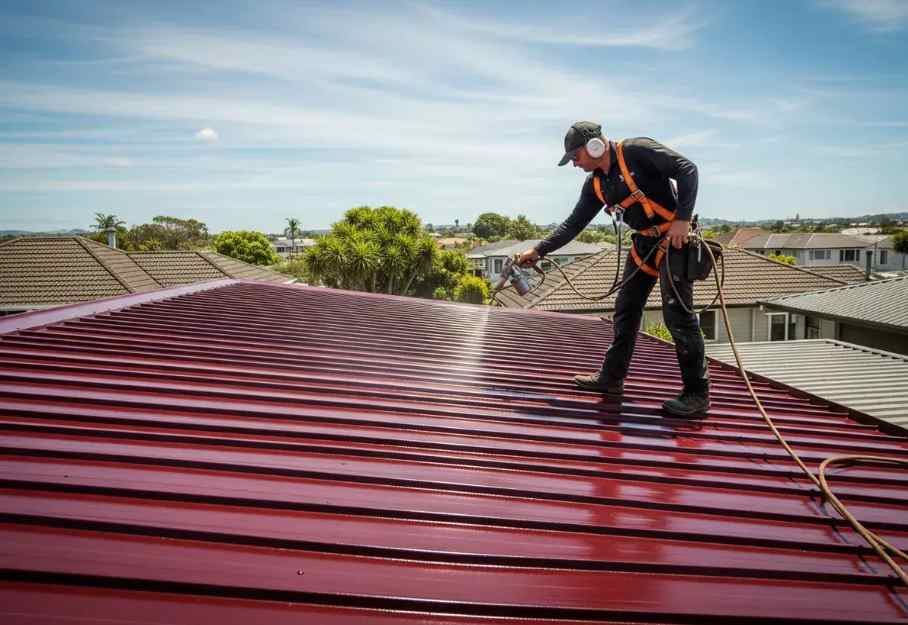
There’s a reason Auckland metal roofing dominates the residential and commercial roofing landscape in a way it doesn’t in most other comparable cities. It’s not fashion. It’s a straightforward match between what Auckland’s climate demands and what metal roofing delivers. High annual rainfall. Salt air across the isthmus from both coasts. UV intensity that exceeds most northern hemisphere environments. Temperature cycling between cool winter nights and warm summers. Metal roofing handles all of these consistently.
What Metal Roofing Actually Is
Longrun corrugated is the classic profile — the wave pattern used on New Zealand buildings for well over a century. In modern Colorsteel it’s not the corrugated iron of the bach era: it’s pre-painted steel with an eight-layer coating system, warranted for the specific exposure environment, available in a broad colour range. The profile’s corrugations are structural — the wave distributes load efficiently, which is why the same gauge of steel carries more load in corrugated form than it would as a flat sheet.
Longrun trapezoidal (often called longrun or ribbed) is the more common profile on contemporary residential and commercial builds. The ribs run the length of the sheet, providing high stiffness and a clean visual line that suits the broad, clean rooflines of modern New Zealand residential architecture.
Standing seam is the architectural premium option — concealed fixings, continuous panels from ridge to gutter, a smooth unbroken surface that reads as a design element rather than just a roof covering. The fixing system, which clips rather than penetrates the sheet, eliminates the fastener penetration points that are the most common water ingress risk on longrun systems.
Tray roofing suits low-pitch and flat-ish roof sections where conventional longrun profiles don’t drain adequately. The tray profile manages water across lower pitches than corrugated or ribbed systems can handle, and is commonly seen on contemporary residential homes with complex roof geometries.
Colorsteel vs Zincalume
Colorsteel is pre-painted — an eight-layer paint system over the zinc/aluminium alloy coating. The paint is the UV and corrosion protection, and it comes in a wide colour range. Colorsteel is available in grades suited to different exposure environments — your roofer will specify the appropriate grade for the site’s coastal classification, from standard inland environments through to exposed coastal sites requiring enhanced corrosion resistance.
Zincalume is the same steel substrate without the paint layer. The zinc/aluminium alloy coating provides corrosion resistance but not the UV and colour stability of the painted system. Zincalume is typically used on hidden or industrial applications where the exposed finish isn’t a consideration. For roofing and cladding applications on Auckland homes and commercial buildings, Colorsteel is the standard specification.
Why Auckland’s Coastal Environment Changes the Specification
Not all Auckland metal roofing specifications are created equal, and the coastal exposure classification of a site determines which product grade is appropriate. A property within 500 metres of the Waitemata Harbour, the Manukau Harbour, or the west coast beaches is in a high-corrosion zone where standard Colorsteel degrades measurably faster than it does at an inland property. A coastal-grade Colorsteel product is the right specification for these sites.
A roofer with experience in Auckland’s specific coastal zones knows where the boundaries sit. One working from a general specification doesn’t. Cowperthwaite Roofing supplies and installs Colorsteel products sourced from Roofing Industries, Steel and Tube, Metalcraft Roofing, and Dimond Roofing — NZ-manufactured products designed for local weather conditions.
Frequently Asked Questions
How long does metal roofing last in Auckland?
A properly specified and installed Colorsteel roof in a standard inland Auckland environment typically performs for 25-35 years before replacement is required, with maintenance extending this toward the upper end. Coastal properties on correctly specified coastal-grade Colorsteel perform comparably. The variance in lifespan between correctly and incorrectly specified metal roofing in Auckland coastal conditions is significant.
What colours are available for Auckland metal roofing?
Colorsteel is available in a wide range of pre-painted colours across the product range. New Zealand Steel’s current colour range spans from heritage tones to contemporary neutrals and bold statements. Colour choice affects solar heat absorption — darker colours absorb more — worth considering for buildings where ceiling insulation is limited.
Is metal roofing suitable for low-pitch roofs in Auckland?
Yes, within profile-specific pitch minimums. Corrugated has a minimum pitch of 8 degrees after deflection for standard sheet lengths. Trapezoidal profiles suit slightly lower pitches. Standing seam and tray roofing extend to lower pitches still. Below the minimum for any profile, water management becomes unreliable — a specialist will specify the appropriate profile for the actual pitch.
Does metal roofing affect Auckland building consent?
Like-for-like replacement of metal roofing generally doesn’t require consent. Changing the profile type, pitch, or structure typically does. Metal roofing on new builds and additions requires consent regardless. A Licensed Building Practitioner must be involved in consented roofing work — Cowperthwaite Roofing works with LBPs for all consented projects.
The Right System for the Site
Auckland metal roofing done correctly starts with the site: coastal exposure, roof pitch, architectural style, and whether the project is new installation, re-roofing, or repair. The profile, product grade, and colour follow from those parameters. Cowperthwaite Roofing has been specifying, supplying, and installing metal roofing in Auckland since 1906. Get in touch at aucklandroofing.com.