
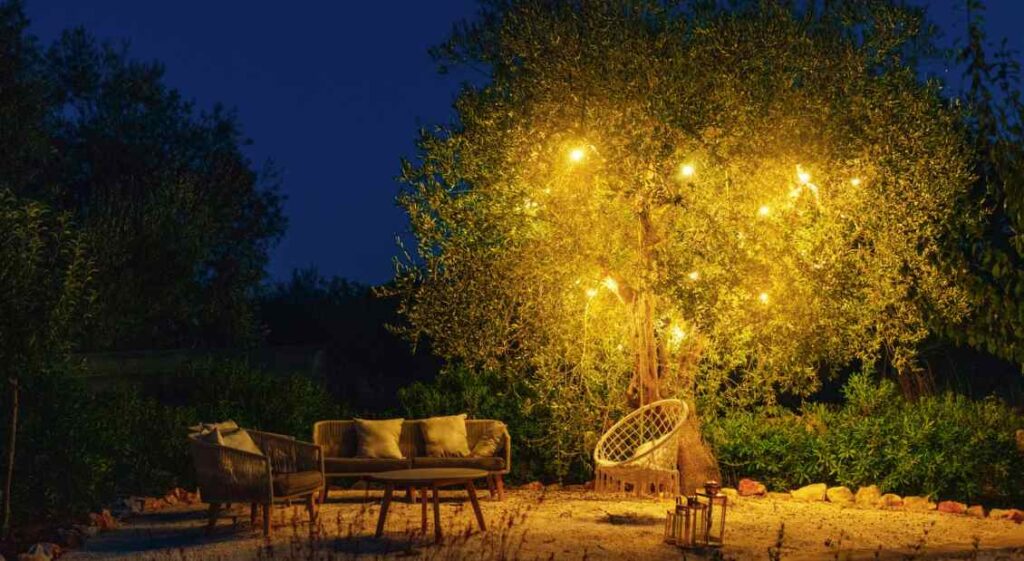
Solar garden lights are attractive in theory. No electrician. No cable run. No transformer. You push a spike into the ground, the light turns on at dusk, and that’s the end of it. In practice, in New Zealand, the picture is more complicated — and for most homeowners wanting a designed garden lighting scheme, it resolves in one direction.
Garden lights in NZ powered by solar face a specific challenge that solar lighting products designed for European or American markets don’t fully account for: New Zealand’s cloudy winter months. The Garden Lighting Company’s position on this is clear: solar fixtures available currently don’t consistently produce the quality of effects achievable with a designed 12V system. Extended cloudy periods reduce light output considerably.
What 12V Systems Actually Provide
A 12V low-voltage system runs from a mains-powered transformer that converts 240V household power to the 12V the fittings use. The Garden Lighting Company’s transformer range runs from 50W to 300W and is IP67 rated — designed to withstand rain, powerful water jets, and short periods of submersion. That IP67 rating matters in Auckland, where outdoor hardware sits in heavy rainfall for months at a time.
What a correctly sized 12V transformer delivers that solar can’t is consistency. The same output every night, regardless of whether the previous day was sunny or overcast. For a designed scheme where the whole effect depends on multiple fittings performing at their rated output simultaneously, this consistency is the non-negotiable foundation.
The Cable Run Question
With solar, each fitting is independent — the panel and the light are one unit. The tradeoff is that each fitting’s output is limited to what its individual panel can generate, and there’s no opportunity to balance the system or add to it without adding more independent units.
With 12V, flexible low-voltage cable runs from the transformer to the fittings, typically under mulch or buried at shallow depth in garden beds. The cable run is what allows fittings to be positioned precisely — not where a panel can get sun, but where the light needs to be for the design to work. For established gardens with mature plantings and specific design requirements, this distinction is often decisive.
Garden Lights NZ: Why Local Conditions Change the Calculation
Garden lights in NZ are operating in conditions that affect product performance in ways that general international product specifications may not capture. UV intensity through New Zealand’s atmosphere is among the highest in the world. Polymer components that perform adequately under northern hemisphere UV loads can degrade visibly faster in NZ conditions.
Rainfall: Auckland averages over 1,200mm annually, with most falling between May and September — exactly the months when outdoor lighting is most needed. Fittings and transformers that are borderline on water resistance develop issues that become apparent in winter. IP67 on the transformer and IP65 or better on fittings is appropriate specification for Auckland, not excessive.
Coastal exposure adds salt air corrosion to the UV and rainfall load. Marine-grade anodised aluminium — used in the Moonscape range — was specifically chosen for this environment, performing on Auckland waterfront properties for over 40 years.
When Solar Makes Sense in a NZ Garden
For low-demand, non-critical applications — decorative markers along a secondary path, occasional accent pieces in a spot too remote for a cable run — solar has a legitimate role. The practical limit is any application where consistent output matters. A feature tree that should be lit every evening needs reliable output. A path used for safety reasons needs reliable output. In these applications, solar’s dependency on recent weather conditions makes it unsuitable as the primary source.
Frequently Asked Questions
Can garden lights in NZ run from solar panels connected to a battery system?
Yes — most Garden Lighting Company fittings can run from a correctly specified solar panel, controller, and battery. This achieves results similar to a mains-powered system, but the equipment cost is substantially higher than a transformer-based system. For most urban and suburban Auckland properties, it’s a more expensive way to achieve the same result.
What transformer size do I need for my garden?
Add up the wattage of all the fittings in your planned scheme and choose a transformer at 70-80% of that total capacity — this leaves headroom for the system to perform at full output and for future additions. The Garden Lighting Company’s transformer range runs from 50W to 300W, covering most residential applications.
How far can cable run from the transformer?
Distance capacity depends on the cable gauge and the load being carried. Heavier gauge cable carries more current over longer distances without voltage drop. A specialist designs the cable run specifically for the system rather than using a standard cable throughout. Voltage drop at the far end of an undersized cable run is the most common cause of fittings that perform below their rated output.
Are there Wi-Fi control options for garden lights in NZ?
Yes — wireless switching and Wi-Fi programmable control solutions are available through the Garden Lighting Company. These allow timer programming, remote control, and scheduling from a phone rather than a manual switch.
The System That Works in All Weathers
A garden lighting scheme designed for Auckland needs to perform on overcast July evenings, not just sunny December ones. That requirement points clearly toward 12V mains-derived systems as the reliable foundation — with solar considered only for specific supplementary applications where consistent output isn’t the primary requirement.
Garden lights in NZ designed and installed by a specialist who understands local conditions, specifies appropriate IP ratings, and sizes the transformer correctly produce a system that performs the same way in June as it does in December.
The Garden Lighting Company has been designing and installing garden lights in NZ since 1984. Over 40 years. 5,500+ projects. NZ-made, 10-year warranty. Get in touch at gardenlights.co.nz.